It seems quite a few people are upset about Firelands not being in patch 4.1. This is being seen as the insult added to the injury of Cataclysm, which is rather light on content.1.
Of course the object of criticism here may be entirely fictional. The fact that Firelands is going to be in 4.2 rather than 4.1 probably has absolutely no impact on how soon we will see Firelands live on the servers.
Suppose instead that Blizzard had announced that because 4.1 was going to take longer than they anticipated, they were going to do a patch 4.0.7 that had some of the content they originally planned for patch 4.1, such as the troll dungeons. The PTRs would be changed to say they were testing for 4.0.7, the patch notes would tell us what to expect in 4.0.7 and so on.
This would be exactly the same thing as what is going on now. Version numbers are totally arbitrary. Even if there are rigid rules that govern how they work they are still totally arbitrary. If people are upset that it isn't coming as soon as they had hoped then that's one thing, but version numbers shouldn't be part of that equation.
Of course from that perspective I think I can agree that no Firelands in 4.1 is a bad move. It's a bad public relations move, though, not a bad game design move. They should release Firelands when they release all of their content: when it's ready.
1, Cataclysm wasn't actually content light. It had tons of content, but a good amount of the content was aimed at characters under level 60. This may have been a mistake - it might have been the game design equivalent of teaching an old dog new tricks. Still, any criticism should be about poorly targeting their efforts, not phoning it in.
Showing posts with label humanity. Show all posts
Showing posts with label humanity. Show all posts
Tuesday, March 8, 2011

Monday, February 28, 2011
Virtual Rewards and Mortality
Tobold has a post about the "trap" of virtual rewards which I posted a medium-sized comment on. Of course these rewards could be achievements, gear, titles, gold, high scores or whatever else a game gives you, and the topic is obviously quite relevant - if not specifically directed at - WoW.
I commented because I wasn't quite sure what he was trying to say. I don't put much stock in the idea that virtual rewards are impermanent, because we are impermanent and everything we do is impermanent. If that disqualified things from having value then nothing would have any value.1 I think, though, the phenomenon that he is concerned with is the following. Please bear in mind this that I don't mean to put words into Tobold's mouth, but just that this is what I understand the problem with virtual rewards to be:
When we first start playing a game, we get really excited by the gameplay, the graphics, the world, or whatever it is we like about the game. Most games quickly start giving us some kind of reward for playing. Our character levels up or we get a new weapon or we unlock an achievement, for example. The reason we like the game is because we actually like playing it, but the rewards we get serve as a point to crystalize our enjoyment around. In order to easily attach value to an activity as a whole, we like to be able to give that activity a beginning, a middle and an end and the end is what gets top billing. This, of course, all has something to do with dopamine, apparently, but whatever the chemical explanation, we do seem to have a fascination with conclusions.
So though we liked exploring the game, we affix all of that like to hitting level 2 or getting a new weapon or whatever. Then we affix a bunch more like to hitting level 3, and so on. We create for ourselves the mythology that we are enjoying the game because of the rewards it gives us. At some point we will have ceased enjoying the actual gameplay, but we will have long since convinced ourselves that the rewards are good, and so we will continue to trudge through gameplay in order to get to the next reward.
Humans, being terrible at knowing what makes them happy, will not realize that this is not making them happy, and will continue doing it, expecting it to make them happy despite the fact that reality has stopped supporting that expectation.
The fact that there are undoubtedly tons of people playing WoW who fall into this category, and tons of people playing other games as well doing this same thing, certainly seems like a problem. Perhaps less of a problem than marrying someone you really don't like or spending your entire life addicted to a damaging substance - two other things that can be caused by the same phenomenon - but a problem nonetheless. People are doing something for fun, and not having fun doing it.
Of course I think Tobold is also concerned with the other effect that this has. The longer a game like WoW exists, the more people are playing it who don't actually like playing it. Those people think that they'd be happier if they got more stuff, so they tell the developers they want more stuff. The developers put in more stuff. The game ends up being all about getting this stuff and it loses the reasons why the people liked it in the first place.
But here's where I think things get a little weird. Yes, the developers eventually start taking out the things that made those games popular in the first place. But no one actually likes those things anymore. People may have come to the game because it was hard as hell, because there were insane grinds, because there was massive travel time and forced grouping. Those are the things I was talking about at the beginning - the things they liked that ended up getting lumped in with the virtual rewards. The whole reason, however, that the virtual rewards became the desired thing was because none of that stuff that originally attracted people to the game is enjoyable for them anymore. If they still loved all that stuff then they'd be getting the same satisfaction out of the game they were in the first place. The reason they are on the virtual rewards treadmill is because the game isn't fun for them anymore. So what value are all those things that have been taken away to make the virtual rewards grind faster? Who wants those things anyway? Just because people liked a game for reason X when they first started playing it doesn't mean they will ever want to play any game for reason X again.
Virtual rewards trapping people into games is more of a function of how people are than how games or virtual rewards are. The real problem here is that our love for games, like everything else, dies.
And this is why the reams of blog posts saying that WoW sucks or that it has gone completely wrong or that it is dying are so depressing. It's like looking in on a eulogy - an angry eulogy all about blaming the person who died. Of course this has nothing really to do with the Tobold post I started off talking about, since it isn't a "look at where WoW went wrong" post.
A lot of people are still genuinely enjoying playing WoW. It is quite possible to do so. Lots of people like getting virtual rewards, not because they've fallen into a trap, but because they are fun to get. If you don't like doing these things anymore, then maybe it's time to give up the game, or at least cut back on it. As long as you actually like doing those things, there is no problem.
Game designers can make better decisions that will help games have more longevity and that will make them better games, but they can't do anything about the fact that the individuals who play their game will stop wanting to play one day. They also can't make a new good game by just resurrecting all the things that made an old game good.
1. The fact that I am personally troubled by the idea of affixing value to impermanent things is a major contributor to me needing drugs to be able to function in society. I don't recommend this, and if you can manage it, I'd go with accepting that impermanence is okay instead.
I commented because I wasn't quite sure what he was trying to say. I don't put much stock in the idea that virtual rewards are impermanent, because we are impermanent and everything we do is impermanent. If that disqualified things from having value then nothing would have any value.1 I think, though, the phenomenon that he is concerned with is the following. Please bear in mind this that I don't mean to put words into Tobold's mouth, but just that this is what I understand the problem with virtual rewards to be:
When we first start playing a game, we get really excited by the gameplay, the graphics, the world, or whatever it is we like about the game. Most games quickly start giving us some kind of reward for playing. Our character levels up or we get a new weapon or we unlock an achievement, for example. The reason we like the game is because we actually like playing it, but the rewards we get serve as a point to crystalize our enjoyment around. In order to easily attach value to an activity as a whole, we like to be able to give that activity a beginning, a middle and an end and the end is what gets top billing. This, of course, all has something to do with dopamine, apparently, but whatever the chemical explanation, we do seem to have a fascination with conclusions.
So though we liked exploring the game, we affix all of that like to hitting level 2 or getting a new weapon or whatever. Then we affix a bunch more like to hitting level 3, and so on. We create for ourselves the mythology that we are enjoying the game because of the rewards it gives us. At some point we will have ceased enjoying the actual gameplay, but we will have long since convinced ourselves that the rewards are good, and so we will continue to trudge through gameplay in order to get to the next reward.
Humans, being terrible at knowing what makes them happy, will not realize that this is not making them happy, and will continue doing it, expecting it to make them happy despite the fact that reality has stopped supporting that expectation.
The fact that there are undoubtedly tons of people playing WoW who fall into this category, and tons of people playing other games as well doing this same thing, certainly seems like a problem. Perhaps less of a problem than marrying someone you really don't like or spending your entire life addicted to a damaging substance - two other things that can be caused by the same phenomenon - but a problem nonetheless. People are doing something for fun, and not having fun doing it.
Of course I think Tobold is also concerned with the other effect that this has. The longer a game like WoW exists, the more people are playing it who don't actually like playing it. Those people think that they'd be happier if they got more stuff, so they tell the developers they want more stuff. The developers put in more stuff. The game ends up being all about getting this stuff and it loses the reasons why the people liked it in the first place.
But here's where I think things get a little weird. Yes, the developers eventually start taking out the things that made those games popular in the first place. But no one actually likes those things anymore. People may have come to the game because it was hard as hell, because there were insane grinds, because there was massive travel time and forced grouping. Those are the things I was talking about at the beginning - the things they liked that ended up getting lumped in with the virtual rewards. The whole reason, however, that the virtual rewards became the desired thing was because none of that stuff that originally attracted people to the game is enjoyable for them anymore. If they still loved all that stuff then they'd be getting the same satisfaction out of the game they were in the first place. The reason they are on the virtual rewards treadmill is because the game isn't fun for them anymore. So what value are all those things that have been taken away to make the virtual rewards grind faster? Who wants those things anyway? Just because people liked a game for reason X when they first started playing it doesn't mean they will ever want to play any game for reason X again.
Virtual rewards trapping people into games is more of a function of how people are than how games or virtual rewards are. The real problem here is that our love for games, like everything else, dies.
And this is why the reams of blog posts saying that WoW sucks or that it has gone completely wrong or that it is dying are so depressing. It's like looking in on a eulogy - an angry eulogy all about blaming the person who died. Of course this has nothing really to do with the Tobold post I started off talking about, since it isn't a "look at where WoW went wrong" post.
A lot of people are still genuinely enjoying playing WoW. It is quite possible to do so. Lots of people like getting virtual rewards, not because they've fallen into a trap, but because they are fun to get. If you don't like doing these things anymore, then maybe it's time to give up the game, or at least cut back on it. As long as you actually like doing those things, there is no problem.
Game designers can make better decisions that will help games have more longevity and that will make them better games, but they can't do anything about the fact that the individuals who play their game will stop wanting to play one day. They also can't make a new good game by just resurrecting all the things that made an old game good.
1. The fact that I am personally troubled by the idea of affixing value to impermanent things is a major contributor to me needing drugs to be able to function in society. I don't recommend this, and if you can manage it, I'd go with accepting that impermanence is okay instead.
Tuesday, February 8, 2011
Saving the World
Last night my wife asked me how my raid went and I said we beat Al'Akir. She said, "Yay! You're a hero!"
Later on, my wife asked me what the ultimate goal of WoW is.1 My first response was "There is no ultimate goal." My second try, after further pressing was, "To beat all the bosses on hard mode, but in a few months there will be new bosses to beat."
Then, in no small part because me talking about things helps her go to sleep, I told her something that started with, "I'm not sure whether the titans created or found Azeroth," journeyed through old gods, the corruption of Deathwing, his recent escape and the ensuing cataclysm and ended with, "So we need to go to the throne of the four winds and defeat Al'Akir, the lord of air; break into the bastion of twilight, defeat the guards and kill Cho'gall to cut off the head of the twilight hammer cult; and stop Nefarian in Blackwing Descent." We're out to save the world.
I really try to avoid writing nice things about WoW in my blog, but recently I've been feeling kind of down from the number of posts I've been reading about problems with the game. I write posts about problems with the game, of course, but it's the doomsaying that really bothers me. Whether it's outlandish claims that Cataclysm is the worst expansion, not only for WoW, but for any MMO ever, or it's people's concluding blog posts because they just aren't having fun playing anymore, it makes me feel like the sorts of problems that I constantly see with the game are somehow adding up to a bigger picture of decline.
But I genuinely like choosing which heal to cast and on whom. The game really is more fun because I'm playing it with other people. I even like running heroics on easy mode2 to get my guild experience. I also really want Sthenno to save Azeroth from Deathwing, even if I need my wife to remind me of that.
WoW is great. Now if they could only do something about the numbers.
1. She had absolutely no idea who Al'Akir was.
2. In 359 gear.
Later on, my wife asked me what the ultimate goal of WoW is.1 My first response was "There is no ultimate goal." My second try, after further pressing was, "To beat all the bosses on hard mode, but in a few months there will be new bosses to beat."
Then, in no small part because me talking about things helps her go to sleep, I told her something that started with, "I'm not sure whether the titans created or found Azeroth," journeyed through old gods, the corruption of Deathwing, his recent escape and the ensuing cataclysm and ended with, "So we need to go to the throne of the four winds and defeat Al'Akir, the lord of air; break into the bastion of twilight, defeat the guards and kill Cho'gall to cut off the head of the twilight hammer cult; and stop Nefarian in Blackwing Descent." We're out to save the world.
I really try to avoid writing nice things about WoW in my blog, but recently I've been feeling kind of down from the number of posts I've been reading about problems with the game. I write posts about problems with the game, of course, but it's the doomsaying that really bothers me. Whether it's outlandish claims that Cataclysm is the worst expansion, not only for WoW, but for any MMO ever, or it's people's concluding blog posts because they just aren't having fun playing anymore, it makes me feel like the sorts of problems that I constantly see with the game are somehow adding up to a bigger picture of decline.
But I genuinely like choosing which heal to cast and on whom. The game really is more fun because I'm playing it with other people. I even like running heroics on easy mode2 to get my guild experience. I also really want Sthenno to save Azeroth from Deathwing, even if I need my wife to remind me of that.
WoW is great. Now if they could only do something about the numbers.
1. She had absolutely no idea who Al'Akir was.
2. In 359 gear.
Tuesday, November 23, 2010
Too Hard and Too Easy
One of the problems with PUG raids is that raid content is generally accepted to be too easy but in reality much of it is too hard for new and casual players. Some time ago, Ardol at World of Warcraft Philosophized posted about why the leveling process doesn't prepare you for raiding. He makes some good points about the differences between solo and group play that contribute to why people manage to be profoundly bad at raiding with their class despite having to go through the leveling process just like everyone else.
Much more importantly to the issue of PUG raiding is that the leveling process, in its current form, doesn't give you the most important skill in raiding: dying, running back, asking yourself what you can do differently next time, and trying again.
In raiding, you have to be ready and willing to lose and to learn from your mistakes. Without this, you really don't have any opportunity to improve your play. But when raids break up after a single wipe, you never have an opportunity to get better even if you are ready and willing to analyze your play and practice.
When a fight isn't explained and a wipe results in everyone just giving up instead of discussing what went wrong, a newcomer to the fight won't even know why they wiped or whether anything could have been done to avoid it. Sometimes to an experienced raider the causes of wipes can be pretty obvious even on a fight they've never seen before. For a new raider, however, how do they know the difference between - to use Toravon as an example - the raid losing because too many people stood too close to a pair of frozen orbs and the healers weren't on the ball; versus the raid wiping because the fight went too long and he got off a lethal white out? Their experience of either will be similar: everything was going fine until suddenly it wasn't and nearly everyone died.
The problem this creates is that not only does leveling not teach you how to raid, raiding doesn't always teach you how to raid. Unless you are raiding with a group of people who actually share their experiences and who are willing to try again, you are just spinning the wheel every time and hoping you come out a winner.
Dying in WoW is of little consequence. Usually it won't waste more than 10 minutes of your time. Using 10 minutes to die is a great use of time if you actually manage to learn something from it.
People often say that WoW has become too easy, but I want to be totally clear about something: WoW is shockingly hard, but the number of things to do in WoW that are actually really that hard are fairly limited. Firefighter, Yogg +0 and heroic Lich King are all very hard. Algalon, heroic Anub'arak, and heroic Sindragosa were pretty challenging as well - even if the former two seemed harder than they really were thanks to limited attempt mechanisms.
But there is a distinct lack of build-up to the encounters of that difficulty. There are parts of the game that don't seem that tough and then the difficulty curve suddenly gets very steep. PUG raids usually want to take on content up to the point where the difficulty ratchets up, but don't want to try to go further because they can't reasonably expect a PUG will win. Because they only take on the content that is "easy" they expect they should win without a great deal of difficulty. This adds to the frustration of losing, increases the chances the group breaks up after a small number of wipes, and reduces the learning opportunities for PUG raiders.
Reversing this trend means having to start early. Players should get used to the idea of dying and trying again before level 10, and should be reminded that that is part of the game as they go through the leveling process. In his inaugural developer blog post, Ghostcrawler points out that the fun of playing on God Mode wears off pretty quickly. That philosophy needs to be applied consistently through the game, not just to heroic raid encounters. The player base should expect that they will need to try more than once to accomplish important things, and they should get used to feeling that good feeling you get when you succeed after failing, learning and practicing.
Much more importantly to the issue of PUG raiding is that the leveling process, in its current form, doesn't give you the most important skill in raiding: dying, running back, asking yourself what you can do differently next time, and trying again.
In raiding, you have to be ready and willing to lose and to learn from your mistakes. Without this, you really don't have any opportunity to improve your play. But when raids break up after a single wipe, you never have an opportunity to get better even if you are ready and willing to analyze your play and practice.
When a fight isn't explained and a wipe results in everyone just giving up instead of discussing what went wrong, a newcomer to the fight won't even know why they wiped or whether anything could have been done to avoid it. Sometimes to an experienced raider the causes of wipes can be pretty obvious even on a fight they've never seen before. For a new raider, however, how do they know the difference between - to use Toravon as an example - the raid losing because too many people stood too close to a pair of frozen orbs and the healers weren't on the ball; versus the raid wiping because the fight went too long and he got off a lethal white out? Their experience of either will be similar: everything was going fine until suddenly it wasn't and nearly everyone died.
The problem this creates is that not only does leveling not teach you how to raid, raiding doesn't always teach you how to raid. Unless you are raiding with a group of people who actually share their experiences and who are willing to try again, you are just spinning the wheel every time and hoping you come out a winner.
Dying in WoW is of little consequence. Usually it won't waste more than 10 minutes of your time. Using 10 minutes to die is a great use of time if you actually manage to learn something from it.
People often say that WoW has become too easy, but I want to be totally clear about something: WoW is shockingly hard, but the number of things to do in WoW that are actually really that hard are fairly limited. Firefighter, Yogg +0 and heroic Lich King are all very hard. Algalon, heroic Anub'arak, and heroic Sindragosa were pretty challenging as well - even if the former two seemed harder than they really were thanks to limited attempt mechanisms.
But there is a distinct lack of build-up to the encounters of that difficulty. There are parts of the game that don't seem that tough and then the difficulty curve suddenly gets very steep. PUG raids usually want to take on content up to the point where the difficulty ratchets up, but don't want to try to go further because they can't reasonably expect a PUG will win. Because they only take on the content that is "easy" they expect they should win without a great deal of difficulty. This adds to the frustration of losing, increases the chances the group breaks up after a small number of wipes, and reduces the learning opportunities for PUG raiders.
Reversing this trend means having to start early. Players should get used to the idea of dying and trying again before level 10, and should be reminded that that is part of the game as they go through the leveling process. In his inaugural developer blog post, Ghostcrawler points out that the fun of playing on God Mode wears off pretty quickly. That philosophy needs to be applied consistently through the game, not just to heroic raid encounters. The player base should expect that they will need to try more than once to accomplish important things, and they should get used to feeling that good feeling you get when you succeed after failing, learning and practicing.
Wednesday, November 17, 2010
A Leader's Responsibility
Wipe aversion is actually very understandable in PUGs. One of the key differences between a PUG raid and a guild raid is that a guild raid is actually pretty certain that they are going to win. Maybe they won't win tonight, or even this month, but raiding guilds don't let that dampen their enthusiasm. When the members of a guild lose faith that they will ever beat an encounter the guild often starts to fall apart. A single boss can not only wipe raids, but it can outright destroy guilds, if it is capable of making people feel that no matter how hard they try and no matter how much they practice they will never win.
In a PUG, winning is far from inevitable. You really might just plain lose and walk away with nothing. It's a potentially disheartening affair, and at some point continuing to fight the boss is throwing good money after bad. If you no longer think the raid is going to succeed, then you should bail and do something more productive with your time.
Much worse than this from a raid cohesion perspective is that once one person leaves, the threshold for another person to leave plummets drastically. After all, the first person has to be unwilling to sit through one more attempt. The second person has to be unwilling to sit through the time it takes to replace the first person plus the time for another attempt, and so on. One person leaving - especially from a 10-player raid - can be enough to set off a cascade.
Obviously no one in a raid wants this to be the outcome, but people running the raids have an additional investment. The majority of people, even people who seem like jerks most of the time, actually have an internal sense that when they start something and it fails, they deserve the blame. That feeling of shame and blame may be warring with other feelings - such as rage against the group's lousy dps - but people mostly don't like to fail and as a raid leader you can't really leave the blame with other people. If the group failed, it's because you put together a bad group.
Unless, that is, you put together the group based on an objective measure that is supposed to tell you whether people are capable of succeeding or not. If you go into 10-player ICC with a group wearing ilvl 264 gear, then you "should" win. If the group can't beat Saurfang and degenerates into name calling then it is pretty easy to say to yourself that the members of the group must have just been bad players.
Because the tool is objective1 the raid leader doesn't have to shoulder the blame for its outcome. The tool really becomes the raid leader; and given that PUG raid leaders rarely explain fights, go over what happened when there is a wipe, give motivational speeches, or talk to individual raid members about how to improve their play, the tool might as well be the raid leader for all other purposes as well.
None of this is to say that PUG raid leaders are wusses or to put the blame for anything on their shoulders. Very few people decide lead PUG raids precisely because being a leader carries with it a burden. Moreover, people who are really great raid leaders are mostly raid leaders in guilds. The skills it takes to be a great raid leader aren't really that different than the skills it takes to be a great leader of people in general. Those skills are not common.
Blizzard thinks that implementing an Raid Finder system similar to the Dungeon Finder system is a problematic idea for a lot of good reasons. GearScore, however, serves as a makeshift Raid Finder that players have created themselves. Using an objective entrance criterion that should theoretically be tied to the group's chance of success takes the raid leader and their responsibility out of the equation.
In an environment where a single wipe can lead to a complete failure, you'll get very few volunteers to shoulder the responsibility for the success of the raid. The number of PUG raid leaders who want to use GearScore to determine raid inclusion is just a consequence of that fact.
1. It isn't really that objective because you have to decide what GearScore you are using as a minimum. My feeling is that most raid leaders choose values that are well above what is really needed to do the dungeons and rely on overgearing rather than appropriate gearing to beat content. Of course they do this for the same reason they use GearScore in the first place - to try to minimize wipes.
In a PUG, winning is far from inevitable. You really might just plain lose and walk away with nothing. It's a potentially disheartening affair, and at some point continuing to fight the boss is throwing good money after bad. If you no longer think the raid is going to succeed, then you should bail and do something more productive with your time.
Much worse than this from a raid cohesion perspective is that once one person leaves, the threshold for another person to leave plummets drastically. After all, the first person has to be unwilling to sit through one more attempt. The second person has to be unwilling to sit through the time it takes to replace the first person plus the time for another attempt, and so on. One person leaving - especially from a 10-player raid - can be enough to set off a cascade.
Obviously no one in a raid wants this to be the outcome, but people running the raids have an additional investment. The majority of people, even people who seem like jerks most of the time, actually have an internal sense that when they start something and it fails, they deserve the blame. That feeling of shame and blame may be warring with other feelings - such as rage against the group's lousy dps - but people mostly don't like to fail and as a raid leader you can't really leave the blame with other people. If the group failed, it's because you put together a bad group.
Unless, that is, you put together the group based on an objective measure that is supposed to tell you whether people are capable of succeeding or not. If you go into 10-player ICC with a group wearing ilvl 264 gear, then you "should" win. If the group can't beat Saurfang and degenerates into name calling then it is pretty easy to say to yourself that the members of the group must have just been bad players.
Because the tool is objective1 the raid leader doesn't have to shoulder the blame for its outcome. The tool really becomes the raid leader; and given that PUG raid leaders rarely explain fights, go over what happened when there is a wipe, give motivational speeches, or talk to individual raid members about how to improve their play, the tool might as well be the raid leader for all other purposes as well.
None of this is to say that PUG raid leaders are wusses or to put the blame for anything on their shoulders. Very few people decide lead PUG raids precisely because being a leader carries with it a burden. Moreover, people who are really great raid leaders are mostly raid leaders in guilds. The skills it takes to be a great raid leader aren't really that different than the skills it takes to be a great leader of people in general. Those skills are not common.
Blizzard thinks that implementing an Raid Finder system similar to the Dungeon Finder system is a problematic idea for a lot of good reasons. GearScore, however, serves as a makeshift Raid Finder that players have created themselves. Using an objective entrance criterion that should theoretically be tied to the group's chance of success takes the raid leader and their responsibility out of the equation.
In an environment where a single wipe can lead to a complete failure, you'll get very few volunteers to shoulder the responsibility for the success of the raid. The number of PUG raid leaders who want to use GearScore to determine raid inclusion is just a consequence of that fact.
1. It isn't really that objective because you have to decide what GearScore you are using as a minimum. My feeling is that most raid leaders choose values that are well above what is really needed to do the dungeons and rely on overgearing rather than appropriate gearing to beat content. Of course they do this for the same reason they use GearScore in the first place - to try to minimize wipes.
Tuesday, November 16, 2010
Reframing the Argument
The fastest way for a discussion to degenerate into uselessness is for each side to convince themselves that the disagreement stems from the other side being stupid. If you assume that you understand someone else's point of view, and that the disagreement is occurring only because they do not understand your, clearly superior, point of view, then you aren't going to get very far1.
Of course, one of the challenges is that people rarely actually articulate the reasons why they are doing something, and often aren't completely aware of the reasons themselves. People rationalize and then argue against the words used to express the other party's rationalizations. It's some pretty fantastically unproductive stuff. It certainly doesn't get any easier when one side never even presents a point of view at all.
People who start raids in trade chat requesting that everyone who comes have a certain GearScore rarely get drawn into the debate about whether GearScore is a useful tool or not. Other people have that debate for them. The arguments against are generally that skill is far more important than gear. The arguments for are generally that since there is no readily available way to measure skill, gear is the best we can do2.
But those arguments actually don't have much to do with the problem or with either side's motivation. Whether or not GearScore is objectively a useful tool for forming successful raids doesn't make a huge difference. The group that doesn't like GearScore doesn't like what relying on GearScore does to the game and to the community. The group that uses GearScore doesn't think that the GearScore haters understand the reality of forming PUG raids.
I completely agree with the GearScore haters and the majority of the WoW blogging community who say that using GearScore to form raids have a negative impact on the game. For me, though, this has nothing to do with the fact that GearScore can't measure skill, and it has a lot more to do with the fact that GearScore can't measure willingness to learn, ability to take direction, social skills, dedication, and any of the other traits that would make someone who has neither gear nor experience a good addition to a raid. The problem with GearScore isn't that it shuts out people who somehow deserve to be on raids, it's that it shuts out people who just want a chance to play and learn.
It's also worth noting that GearScore can't measure whether or not you are just a complete asshole. When it serves as the only entrance criterion it basically gives people a pass on destructive behaviours and attitudes.
For a trade chat raid leader, though, giving people a chance doesn't seem like a viable option. The reality of PUG raids is very harsh. We all know that a PUG raid can break up after a single wipe at worst, and that for something like Vault of Archavon the lifespan of the raid is half an hour to forty-five minutes maximum even if people are willing to stick it out and try again. A leader under these circumstances doesn't feel like they have any room to give new people a chance.
It's also very questionable whether giving new people a chance is very beneficial in this kind of scenario. No one explains the encounter before it begins. There is no discussion of what went wrong if things do go wrong. The closest thing you are likely to get to constructive advice is being called a "n00b."
The functioning of PUG raids in the current environment seems antithetical to the idea of giving new people a chance to play, to learn and to prove themselves. Despite the attention that GearScore gets, then, it is only a symptom, not the cause, of the problem. The real problem is one that people on both sides of the debate are caught in.
While ultimately if we can solve this problem GearScore may lose its place as a tool of choice for selecting raid membership. But banning or breaking the addon doesn't do anything to the underlying problem that PUG raids are the most obvious avenue for new and casual players to experience raiding and are simultaneously the worst possible environmental for new and casual players to experience raiding.
1. Unless you are in a situation that are are capable of outright winning. When the entire problem has to do with opinions and social interactions it is very rare that this is an option.
2. Of course the arguments are often a lot closer to, "You asshole, you are ruining not only WoW, but life as well!" versus "Noob!" with one side or the other quickly resorting to, "You are a virgin who lives in your mom's basement." This is trade chat afterall.
Of course, one of the challenges is that people rarely actually articulate the reasons why they are doing something, and often aren't completely aware of the reasons themselves. People rationalize and then argue against the words used to express the other party's rationalizations. It's some pretty fantastically unproductive stuff. It certainly doesn't get any easier when one side never even presents a point of view at all.
People who start raids in trade chat requesting that everyone who comes have a certain GearScore rarely get drawn into the debate about whether GearScore is a useful tool or not. Other people have that debate for them. The arguments against are generally that skill is far more important than gear. The arguments for are generally that since there is no readily available way to measure skill, gear is the best we can do2.
But those arguments actually don't have much to do with the problem or with either side's motivation. Whether or not GearScore is objectively a useful tool for forming successful raids doesn't make a huge difference. The group that doesn't like GearScore doesn't like what relying on GearScore does to the game and to the community. The group that uses GearScore doesn't think that the GearScore haters understand the reality of forming PUG raids.
I completely agree with the GearScore haters and the majority of the WoW blogging community who say that using GearScore to form raids have a negative impact on the game. For me, though, this has nothing to do with the fact that GearScore can't measure skill, and it has a lot more to do with the fact that GearScore can't measure willingness to learn, ability to take direction, social skills, dedication, and any of the other traits that would make someone who has neither gear nor experience a good addition to a raid. The problem with GearScore isn't that it shuts out people who somehow deserve to be on raids, it's that it shuts out people who just want a chance to play and learn.
It's also worth noting that GearScore can't measure whether or not you are just a complete asshole. When it serves as the only entrance criterion it basically gives people a pass on destructive behaviours and attitudes.
For a trade chat raid leader, though, giving people a chance doesn't seem like a viable option. The reality of PUG raids is very harsh. We all know that a PUG raid can break up after a single wipe at worst, and that for something like Vault of Archavon the lifespan of the raid is half an hour to forty-five minutes maximum even if people are willing to stick it out and try again. A leader under these circumstances doesn't feel like they have any room to give new people a chance.
It's also very questionable whether giving new people a chance is very beneficial in this kind of scenario. No one explains the encounter before it begins. There is no discussion of what went wrong if things do go wrong. The closest thing you are likely to get to constructive advice is being called a "n00b."
The functioning of PUG raids in the current environment seems antithetical to the idea of giving new people a chance to play, to learn and to prove themselves. Despite the attention that GearScore gets, then, it is only a symptom, not the cause, of the problem. The real problem is one that people on both sides of the debate are caught in.
While ultimately if we can solve this problem GearScore may lose its place as a tool of choice for selecting raid membership. But banning or breaking the addon doesn't do anything to the underlying problem that PUG raids are the most obvious avenue for new and casual players to experience raiding and are simultaneously the worst possible environmental for new and casual players to experience raiding.
1. Unless you are in a situation that are are capable of outright winning. When the entire problem has to do with opinions and social interactions it is very rare that this is an option.
2. Of course the arguments are often a lot closer to, "You asshole, you are ruining not only WoW, but life as well!" versus "Noob!" with one side or the other quickly resorting to, "You are a virgin who lives in your mom's basement." This is trade chat afterall.
Friday, November 12, 2010
GearScore
If you read WoW blogs, or trade chat, it will have been impossible for you to avoid noticing that there are a lot of people out there who really, really don't like GearScore. It was only in the last month or so, when I read a post on the Pink Pigtail Inn that I really got to thinking about why GearScore had become a problem for the community.
So when I saw people complaining that GearScore was meaningless and that "Skill > Gear" I tended to side with the GearScore users. This was a visceral reaction to bad logic. Just because skill is more important that gear doesn't mean that gear doesn't do anything. Since some random guy starting a raid in trade chat has no idea whether some other random guy looking for a raid in trade chat is any good at all at playing the game, there is really no point in comparing the two. Both of the following things can be true at once:
I'd rather have a player in 251s than a player in 232s
I'd rather have a skilled player in 232s than a bad player in 251s
And for all of those "Skill > Gear" people, I would also rather have a bad player in 251s then a skilled player in 187 greens. Skill can't make up that deficit - for reasonable values of bad, at least.
What I was ignoring for a long time is that it's really not my problem. When I raid, I raid with my guild. If I for some reason want to do a PUG raid and they want me to have a certain GearScore to qualify, I have it. More generally, if they want me to have a certain achievement, or meet some other qualification then I have whatever they are looking for. No one has turned me down for a raid and I have little reason to think anyone ever will.
The fact that is isn't my problem, though, suggests that I should ask exactly whose problem it is. When I really got to thinking about this, I decided I should respond to Larisa's post that I linked above. I noticed my response was getting to long so I started writing my own blog post. Unfortunately that got a little too long as well - after some editing, I still have 25 pages on the subject1.
Because that's a little bit more than I would expect anyone to be interested in reading, I wanted to try to express some of the basic ideas I have on the subject more succinctly through a few blog posts. Naturally, I am aware of the fact that very few people actually read my blog, so I don't hit a much larger audience by moving from 25-page-internet-essay format to blog format, but still.
As I said, the key to understanding the problem with GearScore is really understanding who it is a problem for and why we should care. GearScore - and other related problems, like requesting people link an achievement for killing the boss before they are allowed to attend a raid to kill that boss - is a problem for new and casual raiders. It is a barrier to entry for people who want to check raiding out or who like raiding but who don't have a large number of hours to devote to raiding each week.
Just as importantly, I think we should realize that GearScore and achievements are not the problems in themselves. The problem stems from the current climate for PUG raids, and GearScore and achievement requests are band-aids for that problem.
I want to talk about this because I think it is one of the most important issues facing the game. People can say all sorts of negative things about WoW and specifically about the direction the game is heading in, but I think the fundamental answer to most of the complaints is the let people who don't like the game move on to other things and continue to make the game better. The experiment of trying to let everyone - or at least a lot of people - get involved in raiding is an interesting one, and one that was bound to create unforeseen problems. Finding solutions to these problems has a huge potential to improve the game for players of all levels of commitment and interest.
1. If you'd like to read it, it's here, though I wouldn't say it's really finished or polished.
So when I saw people complaining that GearScore was meaningless and that "Skill > Gear" I tended to side with the GearScore users. This was a visceral reaction to bad logic. Just because skill is more important that gear doesn't mean that gear doesn't do anything. Since some random guy starting a raid in trade chat has no idea whether some other random guy looking for a raid in trade chat is any good at all at playing the game, there is really no point in comparing the two. Both of the following things can be true at once:
I'd rather have a player in 251s than a player in 232s
I'd rather have a skilled player in 232s than a bad player in 251s
And for all of those "Skill > Gear" people, I would also rather have a bad player in 251s then a skilled player in 187 greens. Skill can't make up that deficit - for reasonable values of bad, at least.
What I was ignoring for a long time is that it's really not my problem. When I raid, I raid with my guild. If I for some reason want to do a PUG raid and they want me to have a certain GearScore to qualify, I have it. More generally, if they want me to have a certain achievement, or meet some other qualification then I have whatever they are looking for. No one has turned me down for a raid and I have little reason to think anyone ever will.
The fact that is isn't my problem, though, suggests that I should ask exactly whose problem it is. When I really got to thinking about this, I decided I should respond to Larisa's post that I linked above. I noticed my response was getting to long so I started writing my own blog post. Unfortunately that got a little too long as well - after some editing, I still have 25 pages on the subject1.
Because that's a little bit more than I would expect anyone to be interested in reading, I wanted to try to express some of the basic ideas I have on the subject more succinctly through a few blog posts. Naturally, I am aware of the fact that very few people actually read my blog, so I don't hit a much larger audience by moving from 25-page-internet-essay format to blog format, but still.
As I said, the key to understanding the problem with GearScore is really understanding who it is a problem for and why we should care. GearScore - and other related problems, like requesting people link an achievement for killing the boss before they are allowed to attend a raid to kill that boss - is a problem for new and casual raiders. It is a barrier to entry for people who want to check raiding out or who like raiding but who don't have a large number of hours to devote to raiding each week.
Just as importantly, I think we should realize that GearScore and achievements are not the problems in themselves. The problem stems from the current climate for PUG raids, and GearScore and achievement requests are band-aids for that problem.
I want to talk about this because I think it is one of the most important issues facing the game. People can say all sorts of negative things about WoW and specifically about the direction the game is heading in, but I think the fundamental answer to most of the complaints is the let people who don't like the game move on to other things and continue to make the game better. The experiment of trying to let everyone - or at least a lot of people - get involved in raiding is an interesting one, and one that was bound to create unforeseen problems. Finding solutions to these problems has a huge potential to improve the game for players of all levels of commitment and interest.
1. If you'd like to read it, it's here, though I wouldn't say it's really finished or polished.
Wednesday, September 15, 2010
Just Plain Bad
Brightcape's last blog post pointed me to Wolfshead making a post complaining about how the success of MMORPGs has been detrimental to their quality.
Now I decided to make an entire blog that is nothing but complaining about World of Warcraft, so it probably doesn't surprise you to hear that most of the time when I see other people complaining about World of Warcraft I think they are idiots1. Of course "idiots" is purposeful hyperbole, and I certainly don't think from Wolfshead's post that he is an idiot. But I do think that the complaint that WoW is low-quality (or "too easy", "bad", "stupid", etc.) is a little bit spurious.
I appreciate hellish nightmares of games as much as the next guy. I grew up playing Bard's Tale and Might and Magic (1 and 2, not the new fangled stuff with graphics that look like things) and I've sunk countless hours into playing roguelikes. I stuck with the original Legend of Zelda until I could make it to Ganon in both the first and second quest without picking up a sword (you can't kill him without one, unfortunately) and I've beaten Final Fantasy I with four white mages. I like to think I have a little bit of street cred when it comes to RPGs2.
Oldschool RPGs were unapologetically made for hardcore gamers, the only kind of gamer there really was at the time. It was supposed to be an achievement if you could win them, and it actually was. These games often threw you into a world with very little explanation of what was going on, and expected you to solve puzzles that you didn't necessarily know were there. Sometimes you'd meet a dragon on the first level of the dungeon and die instantly. Even worse, sometimes the dragon would be on the third level after you had a really promising start. There was no one to complain to and no one was going to nerf anything for you. If you wanted to play, you sucked it up and took what the game gave you.
I'll admit that I am a little nostalgic for those games. They were super fun, and the fact that no one makes games like that anymore is sad. But WoW was never one of those games.
First of all, WoW was never hard. People beat Molten Core carrying mages who waited for their first frostbolt to hit before they cast another one. Winning strategies for Twin Emps actually require far less concentration and attention than winning strategies for modern bosses. Sure, no one ever beat unnerfed C'Thun but they only tried for a few months. The first Yogg +0 kill came far later after Yogg's release than the C'Thun nerf came after C'Thun's release, and well after many people had "proved" (as they did with C'Thun) that it was mathematically impossible to win.
Second, it's really hard to make a game like that now. The internet is actually a thing. A game of adventure and exploration can only be so hard if you can go and read exactly what to do. Anyone could go download Might and Magic one on an emulator right now, look up a guide, and win it in 15 minutes without going up any levels.
Third, the decision to make games like WoW just plain makes sense. Many of these games we are nostalgic for were labours of love by a single person or by a small team. The fact that they somehow made it onto store shelves in itself is a small miracle. WoW has a really big development team and millions of players. At some point, they decided that it simply did not make sense to devote more than half their development resources catering to 1 or 2% of their players.
It's the third point that is really getting people, I think. The problem is that no one can come up with a constructive solution. There is simply no avoiding the fact that more developer time devoted to one group of players means less devoted to another. There is also no justifying the idea that the developers of a game with 11 million players should be catering to you instead of to a broader audience.
So faced with the fact that the developers are no longer favouring the few elite gamers with all their time and energy, and in the absence of any real argument that it should be any different, we see the vilification of that design choice. And of course, it comes down to money. The marketing department and the stockholders have taken over the developers and nothing is pure anymore.
It's hard when something you like changes in a way you don't like. What makes it even harder is when you can't even get mad about it. Vilifying the people responsible (greed is a sin!) for the decision makes things easier because it brings the anger back, but there in reality there is no wrong here. They are making sensible decisions that are both making them money and making 10 million or more people happy.
Through all this I have saved my biggest complaint for last. Wolfshead is probably the best expression of the argument that MMOs have become tainted by money that I have read, but certainly not the first. And between everyone who has ever complained that WoW or MMOs are getting worse, not a single one has ever quoted Zarathustra:
That everyone can learn to read will ruin in the long run not only writing, but thinking too.
Such a great opportunity lost.
1. This makes perfect sense.
2. I have no street cred in anything else, of course. A dubious achievement!
Now I decided to make an entire blog that is nothing but complaining about World of Warcraft, so it probably doesn't surprise you to hear that most of the time when I see other people complaining about World of Warcraft I think they are idiots1. Of course "idiots" is purposeful hyperbole, and I certainly don't think from Wolfshead's post that he is an idiot. But I do think that the complaint that WoW is low-quality (or "too easy", "bad", "stupid", etc.) is a little bit spurious.
I appreciate hellish nightmares of games as much as the next guy. I grew up playing Bard's Tale and Might and Magic (1 and 2, not the new fangled stuff with graphics that look like things) and I've sunk countless hours into playing roguelikes. I stuck with the original Legend of Zelda until I could make it to Ganon in both the first and second quest without picking up a sword (you can't kill him without one, unfortunately) and I've beaten Final Fantasy I with four white mages. I like to think I have a little bit of street cred when it comes to RPGs2.
Oldschool RPGs were unapologetically made for hardcore gamers, the only kind of gamer there really was at the time. It was supposed to be an achievement if you could win them, and it actually was. These games often threw you into a world with very little explanation of what was going on, and expected you to solve puzzles that you didn't necessarily know were there. Sometimes you'd meet a dragon on the first level of the dungeon and die instantly. Even worse, sometimes the dragon would be on the third level after you had a really promising start. There was no one to complain to and no one was going to nerf anything for you. If you wanted to play, you sucked it up and took what the game gave you.
I'll admit that I am a little nostalgic for those games. They were super fun, and the fact that no one makes games like that anymore is sad. But WoW was never one of those games.
First of all, WoW was never hard. People beat Molten Core carrying mages who waited for their first frostbolt to hit before they cast another one. Winning strategies for Twin Emps actually require far less concentration and attention than winning strategies for modern bosses. Sure, no one ever beat unnerfed C'Thun but they only tried for a few months. The first Yogg +0 kill came far later after Yogg's release than the C'Thun nerf came after C'Thun's release, and well after many people had "proved" (as they did with C'Thun) that it was mathematically impossible to win.
Second, it's really hard to make a game like that now. The internet is actually a thing. A game of adventure and exploration can only be so hard if you can go and read exactly what to do. Anyone could go download Might and Magic one on an emulator right now, look up a guide, and win it in 15 minutes without going up any levels.
Third, the decision to make games like WoW just plain makes sense. Many of these games we are nostalgic for were labours of love by a single person or by a small team. The fact that they somehow made it onto store shelves in itself is a small miracle. WoW has a really big development team and millions of players. At some point, they decided that it simply did not make sense to devote more than half their development resources catering to 1 or 2% of their players.
It's the third point that is really getting people, I think. The problem is that no one can come up with a constructive solution. There is simply no avoiding the fact that more developer time devoted to one group of players means less devoted to another. There is also no justifying the idea that the developers of a game with 11 million players should be catering to you instead of to a broader audience.
So faced with the fact that the developers are no longer favouring the few elite gamers with all their time and energy, and in the absence of any real argument that it should be any different, we see the vilification of that design choice. And of course, it comes down to money. The marketing department and the stockholders have taken over the developers and nothing is pure anymore.
It's hard when something you like changes in a way you don't like. What makes it even harder is when you can't even get mad about it. Vilifying the people responsible (greed is a sin!) for the decision makes things easier because it brings the anger back, but there in reality there is no wrong here. They are making sensible decisions that are both making them money and making 10 million or more people happy.
Through all this I have saved my biggest complaint for last. Wolfshead is probably the best expression of the argument that MMOs have become tainted by money that I have read, but certainly not the first. And between everyone who has ever complained that WoW or MMOs are getting worse, not a single one has ever quoted Zarathustra:
That everyone can learn to read will ruin in the long run not only writing, but thinking too.
Such a great opportunity lost.
1. This makes perfect sense.
2. I have no street cred in anything else, of course. A dubious achievement!
Monday, August 30, 2010
Don't Fight on the Road
I started working on my League of Arathor reputation again, which is a very big grind. If you had a 50/50 split between controlling 2 and 3 bases it would take about 84 hours of continuously sitting in Arathi Basin to get to exalted, and of course in reality there is the 1 minute cap time, the 2 minute start time and the time between games to contend with.
I don't actually mind the old school insane rep grinds. Since these reputations basically give you nothing, the only reason to get them is for show. There is no need to devalue them by reducing the amount of work it takes.
But working on that reputation has meant exposing myself to battleground chat in Arathi Basin. There are so many terrible things about what people say to one another in battlegrounds, but most of it is the same whatever battleground you are in. Arathi Basin has a special stupid thing that people say, "Don't fight on the road!"
If you are losing, someone will yell this almost every time. The basic logic of it is quite astounding. In Arathi Basin both teams have the same objective. Furthermore, you can't have a fight without members of both teams. If I am fighting on the road, it means someone from their team is fighting on the road. If it is bad to fight on the road then it is, on average, equally bad for both teams when a fight on the road occurs. Since bad for your opponent is exactly the same as good for you, fighting on the road can't be bad on its face.
Of course a lot of the time people engage in fighting poorly, they wander away from the flag and allow it to be captured when they easily had enough people to repel the attack, and otherwise get caught in bad positions. Unfortunately the mantra of "don't do bad things, do good things instead" doesn't convey a lot of meaning. "Don't fight on the road," by comparison, conveys meaning. It just conveys a bad meaning that could easily lead people to make bad decisions if they take it to heart.
Perhaps as someone just learning the battleground without a good sense of the strategy it is worthwhile to keep in mind that you always want to be next to a flag so you can either capture if if given the opportunity or stop someone else from capturing it. But diverting and delaying your opponents are extremely useful tactics that usually involve disobeying the rule.
I don't actually mind the old school insane rep grinds. Since these reputations basically give you nothing, the only reason to get them is for show. There is no need to devalue them by reducing the amount of work it takes.
But working on that reputation has meant exposing myself to battleground chat in Arathi Basin. There are so many terrible things about what people say to one another in battlegrounds, but most of it is the same whatever battleground you are in. Arathi Basin has a special stupid thing that people say, "Don't fight on the road!"
If you are losing, someone will yell this almost every time. The basic logic of it is quite astounding. In Arathi Basin both teams have the same objective. Furthermore, you can't have a fight without members of both teams. If I am fighting on the road, it means someone from their team is fighting on the road. If it is bad to fight on the road then it is, on average, equally bad for both teams when a fight on the road occurs. Since bad for your opponent is exactly the same as good for you, fighting on the road can't be bad on its face.
Of course a lot of the time people engage in fighting poorly, they wander away from the flag and allow it to be captured when they easily had enough people to repel the attack, and otherwise get caught in bad positions. Unfortunately the mantra of "don't do bad things, do good things instead" doesn't convey a lot of meaning. "Don't fight on the road," by comparison, conveys meaning. It just conveys a bad meaning that could easily lead people to make bad decisions if they take it to heart.
Perhaps as someone just learning the battleground without a good sense of the strategy it is worthwhile to keep in mind that you always want to be next to a flag so you can either capture if if given the opportunity or stop someone else from capturing it. But diverting and delaying your opponents are extremely useful tactics that usually involve disobeying the rule.
Tuesday, July 27, 2010
Lightwell
I was reading Thespius who referred to Dills regarding spells that should leave the game in Cataclysm. Dills posted a list of spells he believes should be removed and Thespius said that Dills' post was ill-considered.
I basically agree with Dills regarding his list of spells that should go, aside from the "Soothes" which can stay as non-combat class quirk spells that don't really get in anyone's way or affect raid content but make classes feel different, even if only to a few people. Amplify and Dampen are special raid buffs that should either get in a raid buff category and be shared between classes or hit the road. Hunters really don't need three different melee strikes (though I personally think they could certainly keep one melee strike).
But the spell I really want to talk about is Lightwell. Obviously this spell is not a favourite of the community, though it has its die hard supporters. The problem is that debates over Lightwell tend to degenerate into debates about how the game should be played where people lament the fact that in today's GearScore obsessed world everyone just cares about upping their personal dps and can't be bothered to try to keep themselves alive. This annoys me because I don't like nostalgia for imagined pasts, but it also annoys me because it misses that actual problems that Lightwell faces. The biggest problem is that Lightwell isn't good.
The most interesting part of this post and response was an analogy to the made up spell Shadowwell. Imagine you could put a well of darkness on the ground and your healers could click it to do damage to the boss. Would that be a good or a bad spell? It's sort of a silly question without knowing how much damage it does. If clicking it did 200 damage to the boss over 10 seconds and used a GCD then everyone would wonder why the spell existed. If clicking it did 100,000 damage to the boss over 3 seconds and used a GCD then everyone would complain that you needed to stack priests to beat everything because Shadowwell was a necessity. 4k damage over 10 seconds at the cost of a GCD: bad. 50k damage over 60 seconds at the cost of a GCD: good. Pretty much any amount of damage without the cost of a GCD: good. What if the DoT breaks if the target takes a hit for 10k or more? Then it's bad. What if the DoT breaks if the target takes a hit for 30k or more? We don't really care about that.
The numbers actually mean almost everything to whether a spell is good or not. If the numbers are high enough then the mechanic can be as awkward as it wants because people will use it anyway. If the Lightwell HoT didn't break on damage and healed for 10k a second on a 1 second tick for 10 seconds then people would use it for sure. As it is few people use it, and quite rightly.
We all know they could make Lightwell good and we all know they could make it too good. But this is what brings us to the fundamental problem with Lightwell, and the reason it should go. They've been working on this spell for years and they haven't got it yet. Lightwell has always been a contentious spell, and people have always argued that it really isn't that great. When raiding used to be set up in a way that would have made it better, the heal broke on any kind of damage so it was virtually useless on the fights that you most wanted to use it on. They've eased that restriction but it is still there threatening to negate the heal. Fights have become much more dynamic and mobile in the mean time, making useful Lightwell placement difficult on many bosses. On top of that, dps checks have surpassed tanking and healing as the primary factor in whether or not you can win a fight, meaning dps can't afford to switch off target to get a heal on themselves, they have to trust their healers to do their job.
Lightwell has also been very hampered this expansion by the fact that healing is so powerful and fast. A dps choosing when to put a HoT on themselves is pretty meaningless when they might not know whether a 20k heal is about to land on them. Dps should be in a position to judge their own health, but they are not in a good position to plan healing for the raid, and putting a HoT on someone that won't do anything for the next two seconds is a question of healing the raid, not healing that one person. From an individual perspective the tick from Lightwell pretty much always be too little, too late.
And with that powerful healing comes powerful damage. I would love to have the option of putting an extra HoT on myself when I run out to drop off a shadow zone on Halion, but I don't have the luxury of going by an immobile place to do so, and even if I did the ticks from the zone can actually do enough damage to break the heal.
The fast healing and brutal damage will be less of an issue in Cataclysm, so Lightwell might have room to work. But it still comes back to the numbers.
I think on Lightwell the developers have a tough decision to make. Either make it good by making the numbers compelling, or scrap it completely. The breaking on damage feature probably needs to go, the cost should be dropped to virtually nothing and the duration/cooldown extended so you are expected to cast it only once per encounter. Make it the Lightwell untargetable (like a door), so clicking it doesn't deselect your current target. Then make the heal big enough that it can be meaningfully incorporated into a plan for the encounter (e.g. if you get hit with ability X, use the Lightwell or when the boss does ability Y, everyone click Lightwell). But, as Dills says in his post, it's current implementation on position on the tree make it really bad. Making Holy priests takes a spell they don't want to cast to get a talent that is supposed to be a big new feature for them this expansion is not going to make the priest community happy.
I basically agree with Dills regarding his list of spells that should go, aside from the "Soothes" which can stay as non-combat class quirk spells that don't really get in anyone's way or affect raid content but make classes feel different, even if only to a few people. Amplify and Dampen are special raid buffs that should either get in a raid buff category and be shared between classes or hit the road. Hunters really don't need three different melee strikes (though I personally think they could certainly keep one melee strike).
But the spell I really want to talk about is Lightwell. Obviously this spell is not a favourite of the community, though it has its die hard supporters. The problem is that debates over Lightwell tend to degenerate into debates about how the game should be played where people lament the fact that in today's GearScore obsessed world everyone just cares about upping their personal dps and can't be bothered to try to keep themselves alive. This annoys me because I don't like nostalgia for imagined pasts, but it also annoys me because it misses that actual problems that Lightwell faces. The biggest problem is that Lightwell isn't good.
The most interesting part of this post and response was an analogy to the made up spell Shadowwell. Imagine you could put a well of darkness on the ground and your healers could click it to do damage to the boss. Would that be a good or a bad spell? It's sort of a silly question without knowing how much damage it does. If clicking it did 200 damage to the boss over 10 seconds and used a GCD then everyone would wonder why the spell existed. If clicking it did 100,000 damage to the boss over 3 seconds and used a GCD then everyone would complain that you needed to stack priests to beat everything because Shadowwell was a necessity. 4k damage over 10 seconds at the cost of a GCD: bad. 50k damage over 60 seconds at the cost of a GCD: good. Pretty much any amount of damage without the cost of a GCD: good. What if the DoT breaks if the target takes a hit for 10k or more? Then it's bad. What if the DoT breaks if the target takes a hit for 30k or more? We don't really care about that.
The numbers actually mean almost everything to whether a spell is good or not. If the numbers are high enough then the mechanic can be as awkward as it wants because people will use it anyway. If the Lightwell HoT didn't break on damage and healed for 10k a second on a 1 second tick for 10 seconds then people would use it for sure. As it is few people use it, and quite rightly.
We all know they could make Lightwell good and we all know they could make it too good. But this is what brings us to the fundamental problem with Lightwell, and the reason it should go. They've been working on this spell for years and they haven't got it yet. Lightwell has always been a contentious spell, and people have always argued that it really isn't that great. When raiding used to be set up in a way that would have made it better, the heal broke on any kind of damage so it was virtually useless on the fights that you most wanted to use it on. They've eased that restriction but it is still there threatening to negate the heal. Fights have become much more dynamic and mobile in the mean time, making useful Lightwell placement difficult on many bosses. On top of that, dps checks have surpassed tanking and healing as the primary factor in whether or not you can win a fight, meaning dps can't afford to switch off target to get a heal on themselves, they have to trust their healers to do their job.
Lightwell has also been very hampered this expansion by the fact that healing is so powerful and fast. A dps choosing when to put a HoT on themselves is pretty meaningless when they might not know whether a 20k heal is about to land on them. Dps should be in a position to judge their own health, but they are not in a good position to plan healing for the raid, and putting a HoT on someone that won't do anything for the next two seconds is a question of healing the raid, not healing that one person. From an individual perspective the tick from Lightwell pretty much always be too little, too late.
And with that powerful healing comes powerful damage. I would love to have the option of putting an extra HoT on myself when I run out to drop off a shadow zone on Halion, but I don't have the luxury of going by an immobile place to do so, and even if I did the ticks from the zone can actually do enough damage to break the heal.
The fast healing and brutal damage will be less of an issue in Cataclysm, so Lightwell might have room to work. But it still comes back to the numbers.
I think on Lightwell the developers have a tough decision to make. Either make it good by making the numbers compelling, or scrap it completely. The breaking on damage feature probably needs to go, the cost should be dropped to virtually nothing and the duration/cooldown extended so you are expected to cast it only once per encounter. Make it the Lightwell untargetable (like a door), so clicking it doesn't deselect your current target. Then make the heal big enough that it can be meaningfully incorporated into a plan for the encounter (e.g. if you get hit with ability X, use the Lightwell or when the boss does ability Y, everyone click Lightwell). But, as Dills says in his post, it's current implementation on position on the tree make it really bad. Making Holy priests takes a spell they don't want to cast to get a talent that is supposed to be a big new feature for them this expansion is not going to make the priest community happy.
Monday, June 21, 2010
Gearing Up
Recently there has been a good deal of discussion about how gear will be handed out in 10-player and 25-player raids in Cataclysm. Blizzard representatives have waffled on the issue a little bit, which is natural since they are still in the alpha and things could change dramatically between now and release. We know that 10- and 25-player raids will give the same loot, but the goal is that 25-player raids will be more efficient in gearing up the raiders to reward the extra effort of organizing a larger raid.
How can this be accomplished? One suggestion is to have 25-player bosses drop more "badges" to buy gear with, another is to have 25-player bosses drop slightly more loot per person but with the same loot table.
What is ignored in this discussion is that 25-player is more efficient than 10-player at gearing up the raiders with precisely the same loot per boss. Intuitively this is actually pretty easy to understand. Suppose you live in a simple raiding world where a boss can drop five different items, you want one of those items, and you can fight the boss by yourself. Each week you have a one in five chance of gearing up. Suppose instead you have to fight the boss with four friends to defeat it, but the boss drops five items, rolling on its loot table five times. Assuming that your friends want different items (or that some of your want different items at the very least) you can now hand the loot out to the people who need it. If the boss drops item 4 and you want item 2 then at least someone gets item 4. And when you go back next week you know that you have five chances at item 2 and if it drops you get it because the other four people don't want it.
That's a very simple example, but it shows the principle. If we got a roll on the loot table for everyone on the server and then handed out loot to people who need it, almost everyone would get what they wanted, and those who didn't would be virtually guaranteed of getting it the next week.
How does this work in practice? Well, raid loot is pretty easy to simulate. Here is the gearing progress for 10- and 25-player raids fighting bosses that drop 1 item per 5 participants, 12 bosses a week. Tanks are selected randomly from all tank specs, same with healers and dps. 10-player raids are 2 tanks, 3 healers, 5 dps and 25-player raids are 3 tanks, 6 healers, 15 dps. There is one of each type of item in the mix (1 mail shoulder with intellect and another with agility, for example) and the chance of each item dropping is proportional to the number of people who can use it (there is five times as much plate itemized for dps than there is for intellect, for example). Finally, I assume there is only one useful trinket available to each raider despite having two trinket slots (this is how things seem to always work). These assumptions are not what the reality would look like, but they work to show how the curves look. Here is 8 weeks of raiding:

For reference, the bars show the number of shards per raider. Of course because the 10-player raids have less useful loot they have more shards per person. The percentage shows the total percentage of slots filled in the raid. Each person has either 14 or 15 slots, depending on whether they use items in both hands or use a single two-handed weapon.
So after 8 weeks, 70% of 10-player slots are filled. That means the typical 10-player raider has 10 or 11 pieces of gear, leaving 3 to 5 upgrades left in that raiding tier. After the same amount of time a 25-player raider will have 12-ish pieces of gear, meaning they need 2 or 3 more upgrades.
Here's the same chart for 15 weeks of raiding:

You see that both 10-player and 25-player raids are plateauing at this point. Extended infinitely both would tend towards 100%. But for realistic length of time, 25-players raids will tend to gear out their raiders about 95% of the way while 10-player raids will only tend to gear out raiders about 90% of the way.
So 25-player raids don't need more "badges" or more drops in order to gear up more efficiently. They gear up more efficiently by just rotting less loot. In fact, even if 25-player raids get less loot per person, they can still come out on top. This is 15-weeks of raiding with only 4 drops from 25-player bosses:

On this chart we see that while the 25-player raid starts out pretty even, it pulls ahead as time goes on.
What we have here, then, is really a problem with innumeracy. People want there to be an incentive to raid 25-player because it is harder to raid 25-player. Finding nine friends you like to play with or nine people who are really pretty good is not nearly as hard as doing the same thing when nine becomes twenty-four. It turns out, though, that if we actually understand how the math works out, that incentive exists with the same rewards per person for both raid sizes.
What should the developers do with this information? In a perfect world I'd say set the drops per boss and "badge" rewards to the same per person for 10- and 25-player raids. In reality, the amount of time they would spend explaining why this makes 25-player raids more efficient is probably pretty prohibitive, and their current plans of giving more rewards to 25-player raiders is probably the better one from their perspective, even if it is a tragedy from mine.
Appendix A:

Appendix B:

How can this be accomplished? One suggestion is to have 25-player bosses drop more "badges" to buy gear with, another is to have 25-player bosses drop slightly more loot per person but with the same loot table.
What is ignored in this discussion is that 25-player is more efficient than 10-player at gearing up the raiders with precisely the same loot per boss. Intuitively this is actually pretty easy to understand. Suppose you live in a simple raiding world where a boss can drop five different items, you want one of those items, and you can fight the boss by yourself. Each week you have a one in five chance of gearing up. Suppose instead you have to fight the boss with four friends to defeat it, but the boss drops five items, rolling on its loot table five times. Assuming that your friends want different items (or that some of your want different items at the very least) you can now hand the loot out to the people who need it. If the boss drops item 4 and you want item 2 then at least someone gets item 4. And when you go back next week you know that you have five chances at item 2 and if it drops you get it because the other four people don't want it.
That's a very simple example, but it shows the principle. If we got a roll on the loot table for everyone on the server and then handed out loot to people who need it, almost everyone would get what they wanted, and those who didn't would be virtually guaranteed of getting it the next week.
How does this work in practice? Well, raid loot is pretty easy to simulate. Here is the gearing progress for 10- and 25-player raids fighting bosses that drop 1 item per 5 participants, 12 bosses a week. Tanks are selected randomly from all tank specs, same with healers and dps. 10-player raids are 2 tanks, 3 healers, 5 dps and 25-player raids are 3 tanks, 6 healers, 15 dps. There is one of each type of item in the mix (1 mail shoulder with intellect and another with agility, for example) and the chance of each item dropping is proportional to the number of people who can use it (there is five times as much plate itemized for dps than there is for intellect, for example). Finally, I assume there is only one useful trinket available to each raider despite having two trinket slots (this is how things seem to always work). These assumptions are not what the reality would look like, but they work to show how the curves look. Here is 8 weeks of raiding:

For reference, the bars show the number of shards per raider. Of course because the 10-player raids have less useful loot they have more shards per person. The percentage shows the total percentage of slots filled in the raid. Each person has either 14 or 15 slots, depending on whether they use items in both hands or use a single two-handed weapon.
So after 8 weeks, 70% of 10-player slots are filled. That means the typical 10-player raider has 10 or 11 pieces of gear, leaving 3 to 5 upgrades left in that raiding tier. After the same amount of time a 25-player raider will have 12-ish pieces of gear, meaning they need 2 or 3 more upgrades.
Here's the same chart for 15 weeks of raiding:
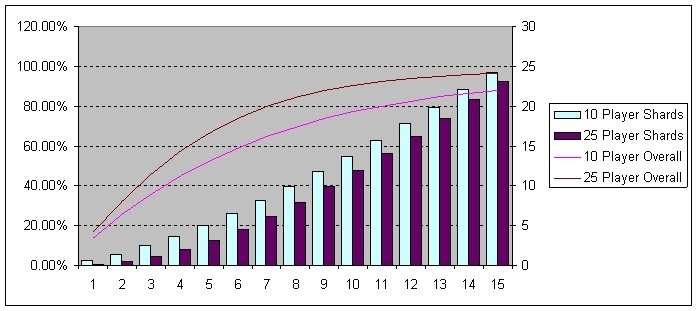
You see that both 10-player and 25-player raids are plateauing at this point. Extended infinitely both would tend towards 100%. But for realistic length of time, 25-players raids will tend to gear out their raiders about 95% of the way while 10-player raids will only tend to gear out raiders about 90% of the way.
So 25-player raids don't need more "badges" or more drops in order to gear up more efficiently. They gear up more efficiently by just rotting less loot. In fact, even if 25-player raids get less loot per person, they can still come out on top. This is 15-weeks of raiding with only 4 drops from 25-player bosses:

On this chart we see that while the 25-player raid starts out pretty even, it pulls ahead as time goes on.
What we have here, then, is really a problem with innumeracy. People want there to be an incentive to raid 25-player because it is harder to raid 25-player. Finding nine friends you like to play with or nine people who are really pretty good is not nearly as hard as doing the same thing when nine becomes twenty-four. It turns out, though, that if we actually understand how the math works out, that incentive exists with the same rewards per person for both raid sizes.
What should the developers do with this information? In a perfect world I'd say set the drops per boss and "badge" rewards to the same per person for 10- and 25-player raids. In reality, the amount of time they would spend explaining why this makes 25-player raids more efficient is probably pretty prohibitive, and their current plans of giving more rewards to 25-player raiders is probably the better one from their perspective, even if it is a tragedy from mine.
Appendix A:

Appendix B:

Friday, March 12, 2010
Brute Force
Q. How do you feel about the limited attempts mechanic that has been use in Trial of the Crusader and Icecrown Citadel?
A. We're not crazy about how they worked out. They were designed in essence to save players from themselves. In the past, some people would make 400+ attempts on new bosses. That's not healthy and at some point you're not measuring skill but tenacity. Yet, that's not what happened. Guilds just made alts to get around the limitations, and things like disconnects and accidents make losing an attempt really frustrating. We like gating because if nothing else it lets the community focus on more than just the final boss in the zone. If we do limited attempts again it would probably be limited to optional bosses like Algalon.
A. We're not crazy about how they worked out. They were designed in essence to save players from themselves. In the past, some people would make 400+ attempts on new bosses. That's not healthy and at some point you're not measuring skill but tenacity. Yet, that's not what happened. Guilds just made alts to get around the limitations, and things like disconnects and accidents make losing an attempt really frustrating. We like gating because if nothing else it lets the community focus on more than just the final boss in the zone. If we do limited attempts again it would probably be limited to optional bosses like Algalon.
This is a quote from a recent developer chat. I'm glad they don't like limited attempts because they are probably the worst idea that has ever been introduced in WoW. What I'm really not glad about is that they are denigrating practice with their comment, "At some point you're not measuring skill but tenacity."
I've seen this a lot recently on various forums and fan sites. Most people seem to have jumped on the anti-practice bandwagon. The words "brute force" are often used when people mean to say "practice." It gives it an ugly tone, but it doesn't change the underlying facts.
Yes, top guilds, in order to earn their world-first positions, put in a lot of hours in the form of long continuous play sessions. This seems rather extreme, and I'm sure that the developer is right that it isn't terribly healthy, but they do it because it is what makes them the best. But the key is that it actually does make them the best, it doesn't just mean they lucked into that position.
Practice actually makes you better at things. Malcolm Gladwell suggests that to be a real master at something you need 10,000 hours of practice. Do you have 10,000 hours of practice playing WoW? If you type /played that would be 416 days and 16 hours. The vast majority of players don't have nearly that many hours played, but I would wager heavily that the majority of the players in world-first competing guilds do. They practice and they get good.
And they practice new fights as well as practicing their characters. The Lich King is not roulette. If it takes 10 or 20 or 40 hours for a top guild to get through a fight it isn't because they had a 1 in 200 chance at winning each attempt and they finally hit it. They had basically no chance of winning their first attempt, and probably a pretty decent chance of winning on their winning attempt. They practiced and got better. This is how WoW works and it is also how everything else works.
There is tenacity in being the best at anything. Olympic athletes need a lot of tenacity to get to where they are, but should we insist that you can only compete in Olympic events if you promise not to spend more than 8 hours a week training for them? Eleven million people play WoW, I would bet that is significantly more than the number of people who have ever been in a four-man bobsled. If you have that many people doing something then some of them will have the tenacity to be the best and others won't.
There is no such thing as brute forcing your way through new content by putting in lots of hours. There is practicing and getting better at it until you can do it.
But for those who think that it is not a measure of skill but only a measure of their ability to dedicate the time when the boss come out, you are wrong about that too. Just like the top-tier athletes, you need to get in a lot of practice to be the best, but that doesn't mean that anyone who puts the practice in will be the best. There is natural talent and ability that factors in. Odds are if you practiced as much as the best in the world you would still not be the best.
Subscribe to:
Posts (Atom)